

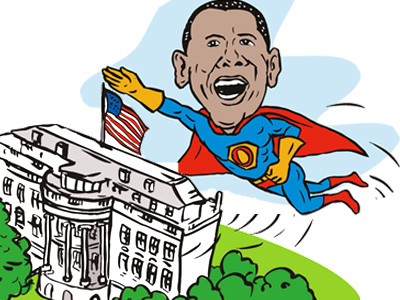
President Barack Obama and his economic team will soon attempt to convince Congress that spending upwards of $1 trillion tax dollars (more or less) will shorten the recession. A good part of the spending will be on public works and infrastructure projects that aim to create (or save) many millions of
jobs. Some of the spending will be in the form of grants to state governments to prevent cutbacks in education and medical services. And a smaller (and laudable) part of the program provides tax relief to some individuals and corporations.Although some economists supported the bank and auto bailouts and although many more support a major federal stimulus package, this economist holds that both measures are counter-productive. Both are likely to prolong the economic slump and not shorten it.
This may seem harsh but the ultimate cure for a recession is recession. Economic booms malinvest labor and capital and recessions are necessary to clean out these malinvestments. Declining prices allow consumers to more easily purchase products (homes, autos) in excess supply; inventories are reduced and supply and demand are brought into balance. And declining profits weed out business organizations and managers that have invested poorly during the boom; bankruptcy allows resources to flow to more profitable areas of the economy. A sustainable recovery is now possible.
It should be obvious that random bailouts can short-circuit the recovery process by propping up poorly performing companies and slowing resource reallocation. With tens of billions in lost profits, General Motors and Chrysler have demonstrated vast inefficiency; yet taxpayer bailouts will preserve their poor management and high-cost union jobs. Worse, other more efficient automobile suppliers will lose sales to Detroit’s dinosaurs and may themselves require subsidies. It just never ends.
The case for bailing out spendthrift state governments or for additional infrastructure spending is equally flawed. Supporters constantly argue that “since consumers won’t spend, governments must spend (to create more jobs).” And since it’s claimed that there are vast unmet public sector needs, what better time to undertake major road construction or help state governments fund programs such as Medicaid.
Some public policies are wrong in both theory and practice; infrastructure spending and bailing out state governments to shorten recessions are examples. In theory, the money to fund the stimulus will have to come from either massive federal borrowing, substantial tax hikes, or pure money inflation by the Federal Reserve. But none of this can remotely promote recovery in the private sector of the economy. All it will do is substitute some private/public sector jobs in one part of the economy for other private/public sector jobs in another part of the economy.
Public spending on major infrastructure projects to fight recession is especially problematic. (Think “Big Dig” in Boston.) Which programs will be undertaken? In which congressional districts? And where will the labor resources come from? Supporters of public works automatically assume that the current increase in unemployment provides a vast army of workers to fill new jobs. Not so fast.
Unemployed workers with vastly different skill levels are scattered unevenly throughout the economy. It is simply unimaginable that even a tiny percentage of them would have the proper skill requirements or would relocate to the politically determined infrastructure projects. In addition, these projects require extremely long lead times (sometimes many years of permits and planning) and are unlikely to begin soon enough to have any near-term effect.
The experience in the 1930s is instructive. Even though federal government spending increased from $9.8 billion in 1934 to $14.2 billion in 1940, the unemployment rate in 1940 was still a staggering 14.6%. A 45% increase in New Deal spending in six years did not end the Depression.
Contrary to economist Paul Krugman and others, the federal government cannot spend us out of our economic quagmire. The best that the government can do is not make things worse. We don’t need more corporate or state bailouts and we don’t need vast public works programs costing many hundreds of billions. We do need more prudent private and public spending, lower taxes on income and investment, and a responsible monetary policy from the Federal Reserve. And we still need lower prices and bankruptcies to finally correct the mistakes of the boom.
Dominick T. Armentano is professor emeritus in economics at the University of Hartford (Connecticut) and a research fellow at The Independent Institute in Oakland, Calif. He is author of Antitrust & Monopoly (Independent Institute, 1998).