

The Hispanic population in the United States grew by 43 percent in the last decade, surpassing 50 million. A Census Bureau projection estimates that one in three U.S. residents will be Hispanic by the year 2050.
The Hispanic population is growing rapidly but only 13 percent of Hispanics have a bachelor's degree or higher education versus 28 percent for the entire U.S. population. More alarming is the fact that about 38 percent of Hispanics have less than a high school diploma.
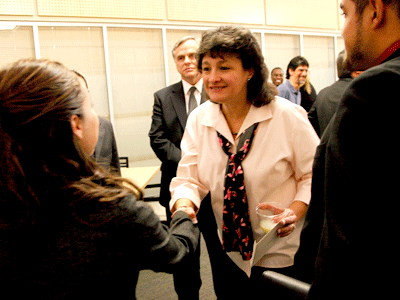
Graciela Tiscareño-Sato, 45, is a resident of Hayward who was born in El Paso, Texas. Her parents migrated to the U.S. from Mexico and they taught her the importance of going to school and studying. Today, she is a bestselling author, a public speaker, and a military veteran. The challenge she has adopted is helping the Hispanic community to achieve more and to share their stories of success with not only other Hispanics, but to mainstream community as well.
“We have so many beautiful, radiant flowers and somehow we are stuck in the fringes and the shadows,” she said. “Someone had to create the positive images of Latinos and to show them over and over again.”
Tiscareño-Sato sees a real challenge when many young people never get to see successful, professional Hispanics.
“They are not surrounded by beautiful examples of educated, accomplished people like them, with origins like them, with families like them, with values like them,” she states.
‘Latinnovating’ is the title of Tiscareño-Sato’s book, which showcases Latino-led innovation in the green economy. The book presents ten case studies of Latinos and Latinas leading companies, innovating new ideas and technologies to retool America’s energy grid, lighting systems, communication infrastructure and much more.
Tiscareño-Sato believes that too many Latino authors are creating content only for the Latino community and she believes that they have to go outside of the community.
“I really believe that we Latinos have to be present in the mainstream,” she says. “That it is absolutely imperative. I write for mainstream media, I speak at mainstream business schools, colleges.”
Her strategy to change perceptions and the low rates of educational achievement is to, “show a different face, show a different story, show a different reality of who we are and the complexity of the community.”
When asked what the community can do to change the perception of the Hispanic community, Tiscareño-Sato says, “Number one is meeting more people and stepping forward and saying I’ve got an amazing story and I want that story to be told. Culturally we do not do that, we do not talk about ourselves.”
Be loud and proud, she says. “Make ourselves more visible.”