

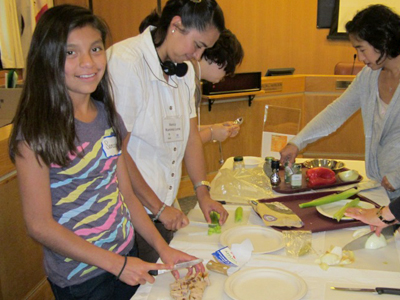
Getting kids to eat more vegetables sounds like mission impossible. Getting kids to grow their own food and enjoy cooking and eating greens and other vegetables sounds like a dream - but it is happening at 33 middle and high schools in the East Bay. Addressing obesity and unhealthy lifestyles among young people is a priority for government and non-government agencies. One-third of school age children in California are overweight or at risk of being overweight. Hispanic kids are more likely than other groups to be overweight.
Christine Boynton is executive director of Project EAT (Educate, Act, Thrive), which collaborates with school communities through meaningful experiences to inspire behavioral changes that improve health, wellness, and academic success. The program provides nutrition education and focused lessons on producing, procuring, preparing and preserving food. Students, teachers, parents and volunteers work in gardens at the schools.
“We try to get students as close to the activity as possible in order to change their behavior,” says Boynton. “We grow vegetables in the garden, and even cook and eat in the garden. Whatever they grow they will eat.”
Cooking classes with the students are held every month and recipes in both English and Spanish are brought home.
“The kids absolutely love it,” says Boynton, who adds that when the students change their behaviors, they then start to ask their parents if they can buy and cook a certain vegetable at home. Students reported that 51% of them were either purchasing or preparing food for themselves and their families.
“We started at Hayward Unified School District and are now at 33 schools in Hayward, San Leandro, San Lorenzo and Livermore,” says Boynton. “We serve about 20,000 kids and 25,000 parents.”
About 50 percent of the student population in the program schools are Hispanic. In Hayward, it is more than 60 percent.
Project EAT is a program of Alameda County Office of Education and is currently funded by the California Department of Public Health’s Network for a Healthy California. Unfortunately, the program will soon be losing its funding. Donations are accepted as are offers to volunteer to help in the school gardens. Parents can participate by making some of the recipes at home and volunteering in the classrooms or in the garden.