

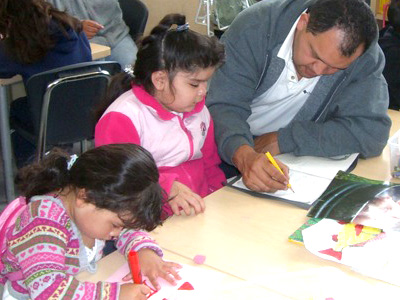
“We don’t need to have an achievement gap,” says Doug Wheeler, referring to the education gap between Hispanic students and other ethnic groups. Wheeler has been a bilingual teacher for 24 years and has spent a lot of time in Mexico, including a year living in Michoacan. “I’ve always had deep affection and respect for the Mexican culture,” he says.
Through his teaching, Wheeler saw that Hispanic parents were very eager to help
in their children’s classroom. Knowing how important parent involvement is in a student’s success, he created a unique teaching program five years ago at Bayview Elementary in San Pablo. Serving a student population that is 66 percent Hispanic, Bayview is one of 64 public schools in the West Contra Costa Unified district.As a bilingual teacher, Wheeler’s class is all Hispanic students, who as a group typically achieve far lower academic success than white or Asian students. Fortunately, Wheeler’s teaching program seems to be reversing this unfortunate reality.
“I teach the parents how to teach their children,” says Wheeler. “They work with their kids for one hour in the class every day – there are nearly as many parents as students in the classroom,” he adds.
Wheeler says the key is to make parents feel welcome enough that they will actually come to class. This includes welcoming parents who bring their pre-school kids, who often learn alongside their older brother or sister in class.
Wheeler says that the program is very successful - his kindergarten students are reading and writing at the first grade level. Such performance would not be possible if Wheeler was not teaching the parents to practice the classroom lessons at home. The students’ achievement is even more remarkable since many of the parents themselves have limited education and limited language skills. “We’ve worked together so that they have the tools to teach their own children,” he says.
Gabriela Hernandez, mother of six year-old Oriana, attends Wheeler’s class with her two year-old daughter Fiorela every day for at least forty minutes. Hernandez saw the progress of Oriana in only two months.
“My girl Oriana learned how to read in only two months,” Hernandez said very excited. “Parents have an opportunity to help their kids and my advice is that they (parents) should not be thinking if they could do it or not - it is the best that could happen - they are not going to regret,” she asserts.
Hernandez added that her two year-old Fiorela is also learning. “In the classroom she tried to make the sounds that the teacher was saying,” she says. “Also she was very alert when the teacher was reading - she was paying attention.”
“I am always going to be “agradecida” with teacher Wheeler,” Hernandes adds. “I would like that other teachers follow his system of teaching.”
Wheeler feels that other bilingual teachers can empower parents in the same way if they, “open their door and make their schedule flexible so they can do the same kind of strategic teaching. Teachers are uncomfortable with real participation of parents,” he states.
Wheeler believes that teachers and administrators have to be break away from the traditional roles, rules and regulations of public schools. “It’s not a problem of knowing what to do but a matter of will. It’s about sincerely willing to change our practice to do what has to be done. It can be done,” he asserts.
Wheeler gives a lot of credit to former Bayview principal Merrilee Cavenecia, who originally gave him permission to host the parents in the classroom. At a recent retirement event for Cavenecia, he spoke about her courage in taking the risk of allowing parents with small children to spend a lot of time in the classroom. In attendance were the mayor and vice mayor of San Pablo, school board member Antonio Medrano and the mayor of Richmond. Wheeler says that they all seemed pleased and impressed with her actions.
Speaking of the great dissatisfaction that people have with the performance of public schools, Wheeler questions the system. “Do we really care? “Are we really sincere about opening up to significant participation by the parents to change things? If we do that, we won’t be talking about an achievement gap.”