

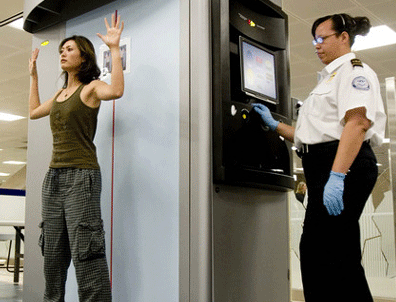
Officials from the Transportation Security Administration (TSA) and Port of Oakland recently held a news conference to announce advanced imaging technology (AIT) at Oakland International Airport (OAK). Members of the news media were invited to see a demonstration of the body scan technology and observe the steps TSA has taken to protect passenger privacy of imaging technology screening. The new units are installed and now operating at Terminal 1.
Advanced imaging technology screens passengers for metallic and nonmetallic threats, including weapons and explosives. It detects items that may be concealed under a passenger’s clothes and allows TSA to screen without physical contact. Backscatter imaging technology projects low level X-ray beams over the body to create a reflection of the body, which is displayed on a monitor. TSA has ensured strict privacy protections are in place and the technology is optional for all passengers.
There is a long standing privacy debate related to scanning machines, which have the ability to display precise anatomical detail. There is also concern about the ability to store and transmit body scan images. TSA and other federal agencies have defended body scanning by insisting that images cannot be stored, transmitted or printed.
However, the U.S. Marshals Service admitted in early August that it had saved tens of thousands of images recorded with a millimeter wave system at the security checkpoint of a single Florida courthouse.
The Electronic Privacy Information Center, a Washington, D.C.-based advocacy group, has filed a lawsuit asking a federal judge to grant an immediate injunction to stop the TSA's body scanning program.
These "devices are designed and deployed in a way that allows the images to be routinely stored and recorded, which is exactly what the Marshals Service is doing," EPIC executive director Marc Rotenberg told CNET. "TSA is not being straightforward with the public about the capabilities of these devices," he added.
TSA has disclosed that it requires all airport body scanners it purchases to be able to store and transmit images for "testing, training, and evaluation purposes." The agency says, however, that those capabilities are not normally activated when the devices are installed at airports.
TSA spokeswoman Sari Koshetz told CNET recently that the agency's scanners are delivered to airports with the image recording functions turned off. "We're not recording them," she said. "I'm reiterating that to the public. We are not ever activating those capabilities at the airport."
According to TSA, airport passengers who decline the imaging technology screening will receive alternative screening, which includes a physical search. Scanning machines are currently being installed at every major airport in the country. President Obama’s fiscal year 2011 budget requests funding to purchase and deploy an additional 500 AIT machines. Currently, TSA has 157 imaging technology units at 43 airports and plans to deploy a total of 450 imaging technology units this year.